

Understanding California Senate Bill 1192 and how it addresses continued abuse through the legal system
Published October 2026 · By Maria Jessica Quiroz, LMFT · The Couples Therapy & Reunification Counseling

Law status: Signed September 30, 2026 · Takes effect January 1, 2027.
Leaving an abusive relationship takes courage, but for some survivors the abuse continues through repeated court filings, hearings, and legal bills. The California Reclaim Act, SB 1192, is the state's response to this form of post-separation abuse. This guide explains what the law will do, how ongoing legal conflict affects families, and where healing can begin.
Key Takeaways
California's Reclaim Act (SB 1192) was signed on September 30, 2026, and takes effect January 1, 2027.
The law addresses litigation abuse, the misuse of court processes to harass, intimidate, or control a former partner.
Ongoing legal conflict can take a real emotional toll on parents and children alike.
Trauma-informed therapy can offer support alongside guidance from a qualified attorney.
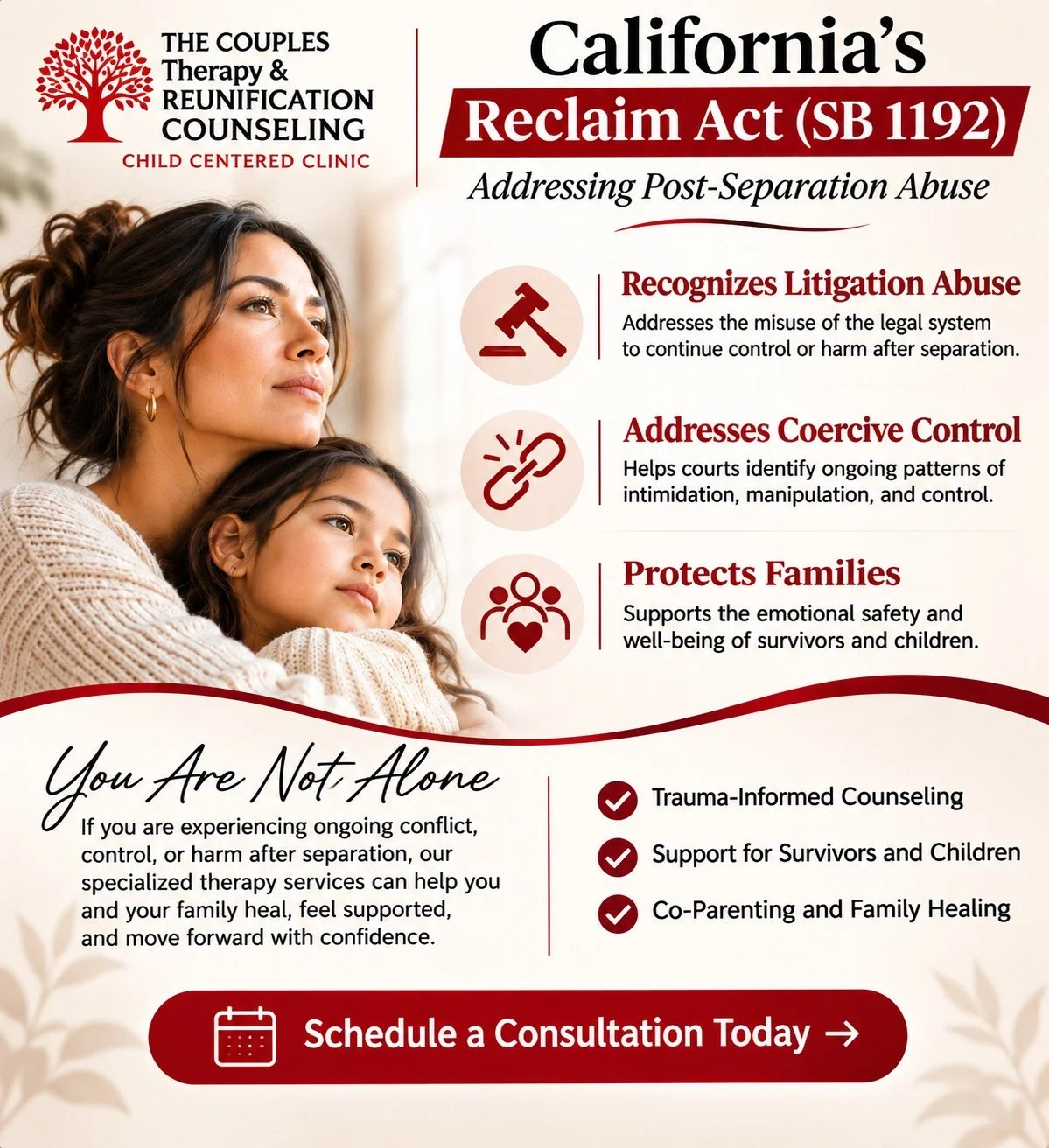
What Is California's Reclaim Act, SB 1192?
Governor Gavin Newsom signed SB 1192, authored by Senator Susan Rubio, on September 30, 2026. The law addresses litigation abuse, a form of post-separation abuse that builds on California's earlier recognition of coercive control as domestic violence. It takes effect January 1, 2027.
What Is Litigation Abuse?
In general terms, litigation abuse describes the misuse of court processes, such as repeated filings or intrusive requests for personal information, to harass, intimidate, or financially drain a former partner. It is different from ordinary high conflict, where disagreements and custody disputes are part of resolving real issues. Only a court can decide whether specific conduct qualifies.
What the Law Is Designed to Do
In general terms, the law will allow a court, after a hearing and specific findings, to require permission before certain new filings are brought against a qualifying survivor. It does not change custody or decide who is right in a family dispute.
Please note: We are therapists, not lawyers. For any questions about SB 1192 or your legal situation, please contact a qualified California family law attorney.
The Emotional Toll of Family Conflict
What we see clinically: Prolonged conflict and litigation can create chronic stress, anxiety, emotional exhaustion, and uncertainty, often intensifying emotional wounds rather than resolving them.
Many survivors describe living "between hearings," where a single court notice can disrupt sleep, work, and parenting. High-conflict situations can also activate unresolved trauma, unhealthy communication patterns, and defensiveness that last long after litigation ends. These reactions reflect a nervous system trying to stay safe, not a personal weakness.
How Ongoing Conflict Affects Children
What children need: Children need permission to love both parents without guilt, fear, or pressure, provided those relationships are safe.
Children exposed to ongoing parental conflict may experience divided loyalties, insecurity, guilt, and anxiety that can shape their attachment, emotional regulation, and sense of safety. When a child resists a parent, careful assessment matters, as our article on estrangement vs. alienation explains. Support may include child-centered play therapy, Child-Parent Psychotherapy, or teen therapy.
Why Therapeutic Support Matter
Our clinical focus: We address each family member's emotional needs while prioritizing children's psychological safety.
One of the most concerning consequences of prolonged family conflict is its effect on children.
Our goal is to help families build healthier communication, emotional regulation, and healthy boundaries, and to rebuild relationships when clinically appropriate. Because high conflict and domestic violence are not the same, safety guides whether joint sessions or reunification therapy are appropriate. Therapy should never pressure anyone to overlook credible safety concerns, a principle at the heart of our clinical approach.
How Therapy Can Help During Legal Stress
Therapy offers a steady, confidential space while legal matters unfold. In individual counseling, we help clients manage anxiety around hearings, understand trauma responses, and set healthier boundaries in co-parenting communication. For children and families, our clinicians focus on emotional safety, stability, and age-appropriate support through transitions. Legal questions belong with your attorney, and with your consent we can collaborate with your legal team on the clinical side.

Finding Calm During Legal Stress
Legal matters take time, and healing can begin alongside them. Call (562) 774 - 6787 to find support.
How Our Practice Supports Individuals and Families
Every service begins with an individualized assessment, with safety at the center.
Individual Counseling for legal stress, anxiety, or trauma
Court-Ordered Therapy for families with a court order
Reunification Conjoint Therapy to rebuild parent–child relationships when safe
12-Week High-Conflict Co-Parenting Program for co-parents stuck in conflict
Parental Alienation Coaching for parents concerned about a child's resistance
Family Therapy for healthier family communication
We see clients in Montebello, Newport Beach, and by telehealth across California, and we accept Aetna and Medi-Cal.
Attorneys: explore our clinical reports, the Quiroz Bridge Model, and our referral process, or schedule a 25-minute case review.

Supporting Families Through Every Step
Our clinicians help individuals and families build healthier connections, with safety at the center.
Frequently Asked Questions (FAQs)
What is the California Reclaim Act (SB 1192)?
It is a California law, signed September 30, 2026, that lets courts restrict abusive litigation and discovery against qualifying domestic violence survivors.
When does SB 1192 take effect?
The law takes effect January 1, 2027, so its new protections are not available before then.
What is litigation abuse?
Litigation abuse is the misuse of lawsuits, repeated filings, or intrusive discovery to harass, intimidate, or financially drain a former partner.
Can therapy help with the stress of ongoing court proceedings?
Trauma-informed therapy may help you manage anxiety, set boundaries, and rebuild confidence, and our team offers it in Montebello, Newport Beach, and by telehealth across California.
Meet Our Therapists
Our clinicians bring specialized training in family court, trauma, and reunification work.
 Maria Jessica Quiroz
M.S., LMFT · Founder & Clinical Director
Court-ordered reunification, high-conflict co-parenting, trauma-informed family therapy
View profile →
 Michelle Cortez
M.S., AMFT · Lead Therapist
Trauma and PTSD, reunification and parent-child repair, co-parenting support
View profile →
 Elicet Gonzalez
AMFT, PsyD Candidate
Reunification therapy, child and play therapy, neurodiverse couples and families
View profile →
 Jozlyn Torres
M.A., AMFT
EMDR and trauma, domestic violence recovery, child-centered play therapy
View profile →
Associate Marriage and Family Therapists (AMFT) practice under licensed clinical supervision.
Meet the full clinical team →Begin Your Healing Journey
If you are experiencing anxiety, emotional distress, trauma, or difficulty navigating the effects of a harmful relationship, professional counseling may be a supportive place to begin. At The Couples Therapy & Reunification Counseling, we help individuals and families build healthier relationships
Call or text: (562) 774-6787
Aetna & Medi-Cal accepted
Montebello · Newport Beach · Telehealth
If you are in danger, call 911; for confidential support, call the National Domestic Violence Hotline at 1-800-799-SAFE (7233) or text START to 88788.
Additional Resources
Educational disclaimer: This article is for general education only and is not legal advice or an individualized clinical assessment; we are not lawyers, so please contact a qualified California attorney with any law-specific questions.